
Ludwig Mies van der Rohe
Ludwig Mies van der Rohe (Aachen, Germany, March 27, 1886 - Chicago, Illinois, August 17, 1969), architect and industrial designer. He directed the Bauhaus from 1930 until its closure in 1933.Live and work
 Ludwig Mies van der Rohe was born on March 27, 1886 in the city of Aachen (Germany), son of Michael and Amalie (Rohe) and fourth son of a Catholic family. In 1900 he began working in the stone sculpture workshop of his father and in 1905 moved to Berlin to assist in the architecture studio of Bruno Paul.
 In 1907 he made his first work, the house Riehl. From 1908 to 1911 worked in the office of Peter Behrens, of which, Mies developed a style of architecture based on advanced structural techniques and Prussian Classicism. He also made innovative designs with steel and glass. In 1911 he directed the construction of the German Embassy in St. Petersburg. In that year he moved to The Hague and planned a cottage for marriage Kröller-Müller.
 In 1912 opened with great effort his own studio in Berlin. During the early years received very few orders, but the early work already showed the way to continue throughout the rest of his career. In 1913, with his wife Ada Bruhn, he moved to Werder (on the outskirts of Berlin). Marianne daughters were born there and Waltrani, and later Dorothy. Until then the relationship between family and work had been good, but the First World War of 1914-1918 caused Ludwig should go to Romania during this period and the family quedase separately.
In 1922 he became a member of "Novembergruppe" and his name Mies van der Rohe. Along with van Doesburg, El Lissitzky and Richter in 1923 edited the magazine "G". From their participation in G, was strongly influenced by the neo Van Doesburg. In those years, he worked at the two country houses made of brick, whose extensive walls and faded lines revolutionized the concept of home.
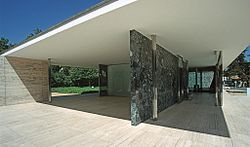
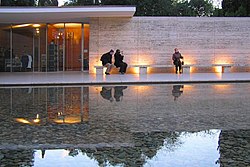
In 1926 he was vice president of the Deutscher Werkbund and carried out works of a certain size, as the Wolf House in Guben, all brick, and the house Hermann Lange in Krefeld. He was director of the Weissenhof housing exhibition in Stuttgart in 1927, where he met and interior designer Lilly Reich and designed for her an apartment block of steel structures. From 1927 to 1930 he built a villa in Krefold for silk manufacturer Hermann Lange, and in 1929 he was commissioned Mies to design the national flag of Germany to the International Exposition in Barcelona, for which he also designed the famous Barcelona chair, steel chrome and leather.
In 1930 completed the Villa Tugendhat in Brno (now Czech Republic) and directed the Bauhaus in Dessau until it closed in 1933 due to pressures to change the system of school study. The developments in Germany forced him to emigrate to America in 1937, where he was appointed director of the Faculty of Architecture of Illinois Institute of Technology in Chicago later remodeled to be dedicated to teaching and research, and were completed throughout the 50's.
In 1940 Marx met Lora, who would accompany him to his death. In 1944 he becomes a citizen of the United States. From 1945 to 1950 built the Farnsworth House in Illinois.
Between 1948 and 1951 to realize her dream of building a glass skyscraper with the two towers of Lake Shore Drive Apartments in Chicago, and later the Commonwealth Promenade Apartments, also in the same city (1953-1956).
Among his most emblematic works of this period highlights the Seagram Building (1958), a skyscraper of 37 floors of glass and bronze built in New York with his disciple Philip Johnson.
In 1959 he retired from the Illinois Institute of Technology.
From 1962 to 1968 built the National Gallery in Berlin. This is a building dedicated to exhibitions of works of art, consisting of a large square room made entirely of glass and steel and situated on a large terrace of granite slabs.
On August 17, 1969 in Chicago dies leaving a legacy of a new fee structure for the architecture as disclosed under its slogans "Less is more" ("Less is more") and "God is in the details" ("God is in the details "), which considers it as one of the most important masters of modern architecture.

No hay comentarios:
Publicar un comentario